Puddles, seams and drains on flat and low-slope roofs
Flat Roof Repair in Montclair, NJ
Is that puddle supposed to be there? Flat and low-slope roofs over Montclair-area additions, porches and rear kitchens give out at seams, drains and edges. Next step: call (973) 358-8198 and say how long the water sits after a rain.
Stop and get safe if
- A ceiling under the flat roof that is bulging, or dripping at a light: get out of the room, touch nothing and call 911 from outside the wet area.
- Deep water standing on the roof after a storm: keep off it, since a wet low-slope roof is slippery and the deck may be carrying extra weight.
- A wire hanging or lying near the roof edge: keep 30 feet away, then pass the report to PSE&G's line, 1-800-436-7734, or to 911.
- Ice over a drain or along the parapet: do not chip it with a hammer or climb up to clear it.
Reading a puddle over 48 hours
- Hour zerorain stops. Note where water collects and whether the drain is moving it.
- Next morningsome shallow water is common. Photograph it with something in the frame for scale.
- Two days onwater still in the same spot meets the trade group's definition of ponding. Note it and the date.
- After the next rainif the puddle sits in the same low spot again, call (973) 358-8198; the pattern is the information the roofer needs.
Where the trouble starts
- Ponding: water left on the surface for 48 hours or longer
- Drains and scuppers choked with leaves, seed pods and grit
- Too little slope in the deck; the trade group's usual minimum is a quarter inch per foot
- Seams and edges opened by freezing, thawing and moving ice
- Rooftop equipment or air conditioner condensate draining onto the membrane
Short answers
- How urgent is a flat roof leak, by your number out of ten?
At 8 to 10 you are looking at water at a fixture, a bulging ceiling or a wire down, so get out and phone 911 or PSE&G. At 4 to 7 a stain under the flat section grows after rain, so call (973) 358-8198 before the next one. At 1 to 3 a small puddle drains in a day or two, which is photograph-and-watch territory.
- How many hours of standing water is too many?
By the Asphalt Roofing Manufacturers Association's definition, ponding is water that stays on the roof 48 hours or longer, and a roof is meant to drain freely over its life. Water that is gone by the next afternoon is a different story from a puddle still there after a weekend.
- Does slope matter on a roof that looks level?
A lot. The same trade group gives about a quarter inch per foot as the usual minimum and notes that tapered insulation can add slope where the deck is too flat. Water also adds load, and a deck that sags creates more ponding.
- What do ice, algae and dirt do to the membrane?
The trade group's 2024 paper says moving ice can scrub the membrane, algae and plants can attack it, and dirt that dries in a ponded spot can crack and pull at the surface. It also says ignoring ponding may shorten the membrane's life.
- Does a flat roof call cover Bloomfield and Clifton?
Yes. Both have flat-roofed additions, and the pages for Bloomfield roofing and Clifton roofing show how old the houses are. Your move: call (973) 358-8198.
Seams, drains and the corner puddle
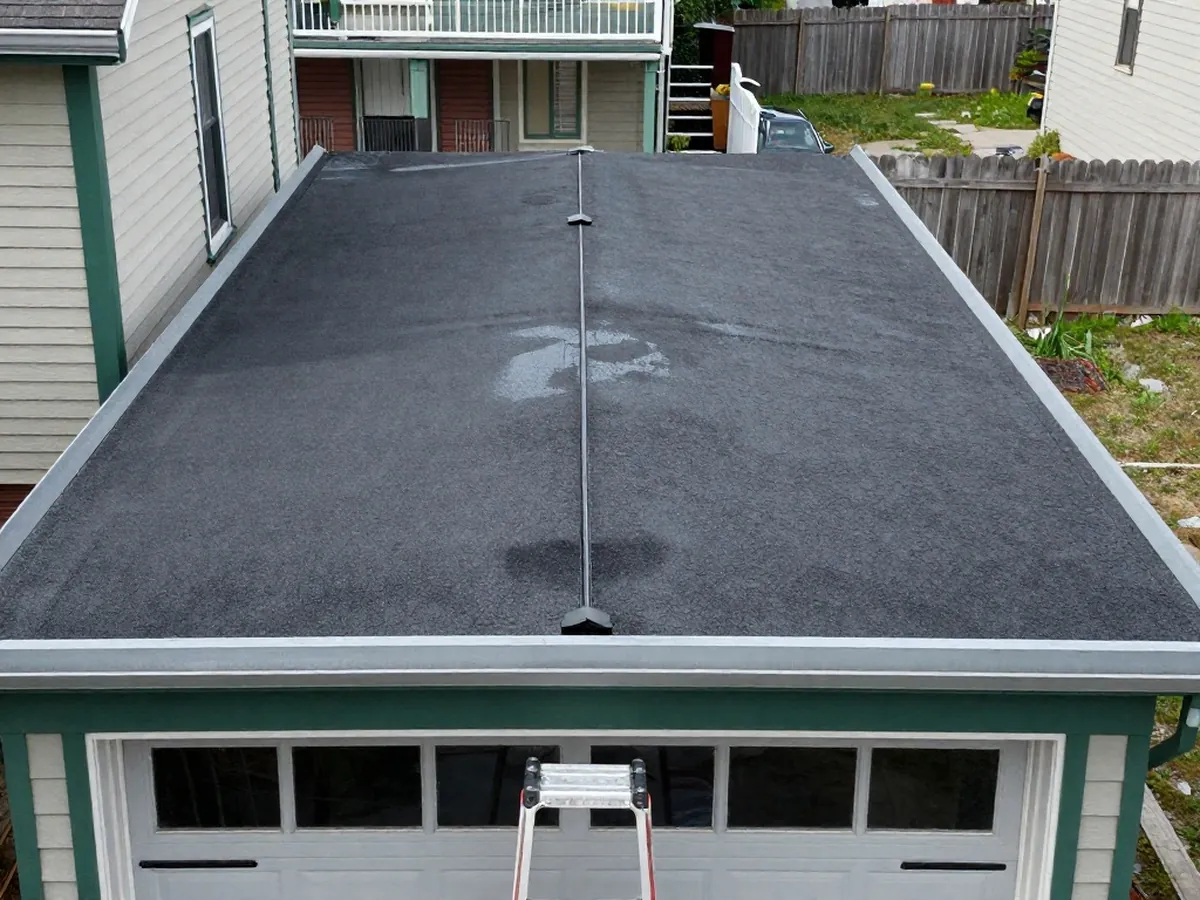
The picture shows a rubber roof over a rear addition, with a seam, a round drain and a shallow puddle near one corner. The three are connected. A drain placed above the low point leaves water behind, and water that stays gets into the seam sooner or later.
The rubber roof is a rendered scene, not a photo of a particular addition.
On a visit
- Call (973) 358-8198 and describe where the water pools, how long it lasts and what lies below; the contractor can then book a look.
- Drains and scuppers: open, set at the low point, and clear of debris.
- Low spots and slope, with a look for sagging deck or standing-water rings.
- Seams, edges and penetrations, where the membrane meets a wall, a vent or a skylight.
- The membrane surface: scrubbing from ice, algae or vegetation, and cracking where dirt dried.
- Options in plain terms, from drain work and seam repair to tapered insulation or a new membrane, and a question about paperwork.
Recoat, patch or rebuild: how to sort it
- A puddle that drains within two days and a dry ceiling: watch it and keep the drain clear.
- A seam or edge that has opened: ask about a patch with the cause named.
- Ponding in the same low spot after every rain: ask about drain location, slope and tapered insulation.
- A soft or sagging deck: ask for the roof boards to be checked before any new membrane goes on.
- Get the plan and the price in writing.
Flat roofs on additions: paperwork notes
On a one- or two-unit house that stands apart from its neighbors, the state's ordinary-maintenance list includes repair or replacement of existing roof covering, and a low-slope covering counts too. That does not extend to changing the deck, adding drains or framing, so those questions go to the township's building office.
Offices, hours and the contract basics are on the rules page.
More roof jobs
Sources Asphalt Roofing Manufacturers Association, Ponding water basics (10 Mar 2017, modified 4 May 2020) Asphalt Roofing Manufacturers Association, Effects of ponding water on low-slope asphalt roofing systems (30 Oct 2024) NIOSH, Falls from ladders are preventable (reviewed 1 Mar 2024) New Jersey Weather and Climate Network, Remnants of Ida strike New Jersey PSE&G, Downed power lines NJ Department of Community Affairs, Significant changes to minor work and ordinary maintenance (5 Mar 2018)
Describe the roof, then dial.
Before you call (973) 358-8198, find the street address, note which room shows water and jot down roughly how old the roof is. Tenants: the owner arranges roof work, so the landlord hears about it first. Towns: Montclair, Glen Ridge, Bloomfield, West Orange, Cedar Grove, Clifton, Little Falls.